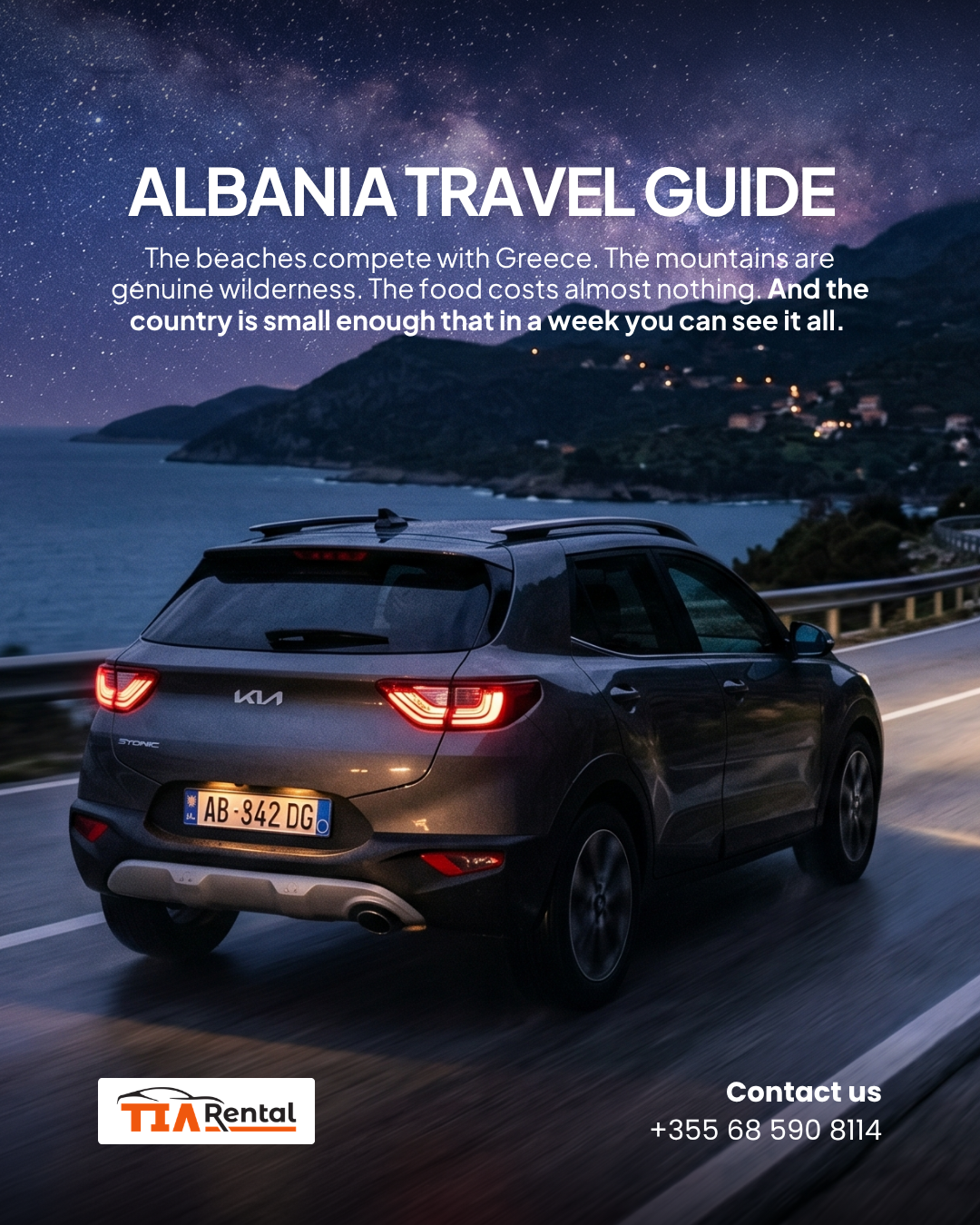
Albania is one of those places that keeps coming up in travel conversations but very few Western tourists have actually been to. The beaches compete with Greece. The mountains are genuine wilderness. The food costs almost nothing. And the country is small enough that a week gives you a real cross-section of it. This Albania travel guide covers the main routes, how to get around, what to budget, and the parts that most guides miss.
One practical note upfront: Albania rewards travellers who have their own transport. The minibus network works but runs on its own schedule. If you want to combine the coast, the capital, and the north in a single trip, a rental car is the straightforward answer.
Albania Travel Guide: Starting in Tirana
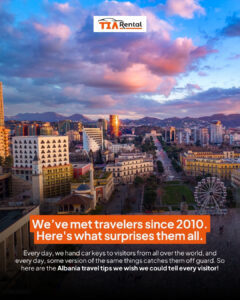
Tirana is the logical entry point. The international airport is on the edge of the city and most rental car offices are clustered nearby. The capital itself is worth a full day at minimum.
Skanderbeg Square is the centre of things, and Albanian cafe culture is built around it. Coffee here costs about one euro, including in the square itself. The city has more cafes per capita than almost anywhere in Europe, a fact that becomes obvious within the first hour. Tirana is not a city of monuments. It’s a city of street life, and the street life is good.
The Bunk’Art museums are both worth your time. Bunk’Art 1 is a vast Cold War-era bunker beneath the city hills, built to shelter government leadership during a nuclear attack. Bunk’Art 2 in the city centre documents the Interior Ministry’s repression during the communist decades. Together they give you a grounded understanding of where Albania has come from.
Getting Around: Car vs. Bus in This Albania Travel Guide
The minibus network, called furgons, connects most cities and towns. They’re cheap and they go almost everywhere. The catch is that schedules are loose. Drivers tend to leave when the vehicle is full rather than at a fixed time, and if you’re trying to catch a ferry or reach a trailhead by a specific hour, that uncertainty matters.
A rental car changes the trip considerably. The main roads between Tirana, Shkodra, Durres, and the south are in reasonable condition. Secondary roads can be rough, particularly in the north. An SUV or high-clearance car is worth it if you’re planning to drive into the Accursed Mountains or along gravel tracks to remote coves.
TIA Rental is 100 metres from Tirana Airport arrivals, family-owned since 2010, rated 4.9 across more than 600 reviews. The team at the desk has driven most of the routes in this guide and can tell you what condition the roads are in right now. For full destination information, Albania’s official tourism portal covers road access, transport options, and accommodation across the country.
One driving note that applies everywhere in Albania: the horn is not aggression, it’s communication. Albanians use it to signal before blind corners, overtaking, or pulling out of side roads. Follow the same logic and you’ll blend in quickly.
Durres: Ancient History on the Albania Travel Route
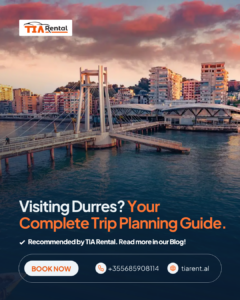
Durres is about 40 minutes west of Tirana on a good dual-carriageway road. It’s Albania’s main port city and home to one of the largest Roman amphitheatres in the Balkans, a 2nd-century arena sitting in the middle of a residential neighbourhood. Entry is free. The city beach is crowded in summer but the town itself, particularly the old walls and the Byzantine-era fortress, is worth a couple of hours.
If you’re driving south from here, the coastal road is the more interesting route. It adds time but gives you access to beaches and viewpoints that the inland motorway skips entirely.
Shkodra and the North
Shkodra is the cultural centre of northern Albania, about 1 hour 20 minutes north of Tirana. Rozafa Castle sits above the city and the Drin and Buna rivers, and the view across the lake from the ramparts is the kind of thing people take home as their defining image of the trip. Entry costs around 3.50 euros. Go in the early evening if you can.
Even in peak summer, tourist numbers here are manageable. Shkodra has a different tempo from Tirana, slower and more traditional, and the old bazaar area near the main pedestrian street is a good place to spend a morning.
Lake Koman Ferry and the Accursed Mountains
This is the part of the trip that most first-time visitors don’t know about and most people who’ve done it say is the highlight of the whole country.
The Lake Koman ferry leaves once a day, early morning, from the reservoir near Shkodra. The crossing to Fierza takes about two and a half hours. The reservoir stretches 34 kilometres through steep gorges and forested slopes. There are no roads along most of it. The ferry is the only way through. It’s one of the most dramatic inland waterways in Europe, and most passengers on it are locals, not tourists.
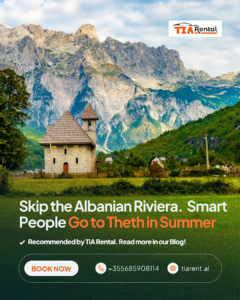
From Fierza, the road continues to Valbona and the Valbona Valley National Park. The valley sits inside the Bjeshket e Namuna range, the Accursed Mountains, with peaks reaching close to 2,700 metres. The hiking here is serious walking in serious terrain. Trails are not always marked and some routes require a guide. For trail conditions and route information, Peaks of the Balkans is the most reliable resource for this region.
The Bunkers: Albania’s Most Visible History
You will see them everywhere. In fields, on hillsides, along the coast, sometimes three or four visible from a single stretch of road. Albania has roughly 170,000 concrete bunkers scattered across the country, built during the Enver Hoxha regime between the 1960s and the 1980s. Hoxha ruled for over 40 years and ran one of the most isolated states in 20th-century Europe, cutting Albania off almost completely from the outside world.
The bunkers were meant to shelter the population in the event of an attack. They were never used for that purpose. They remain as the most tangible evidence of that era, too expensive and too numerous to demolish. Some have been turned into museums (Gjirokastra’s Cold War tunnel is the best example), others into bars or accommodation, most left as they are.
Budget: What to Expect on an Albania Travel Trip
Albania is cheap by European standards. A byrek, the local savoury pastry, costs around 40 cents. A coffee in Tirana’s central square costs one euro. Restaurant meals in local places rarely exceed 8 to 10 euros a head including a drink. Accommodation ranges from very affordable family guesthouses in the north to pricier beach resorts on the Riviera in peak July and August.
The ferry across Lake Koman costs a few euros for foot passengers. Castle entry fees are generally 2 to 4 euros. Petrol is moderately priced. The overall cost of a week in Albania, excluding flights, runs well below comparable trips in Greece, Croatia, or Italy.
Practical Tips from This Albania Travel Guide
Stay in locally run guesthouses where you can, particularly in the north. The money stays in the community and the experience is better. Faria’s hostel in Valbona is the kind of place people mention years later.
Bring flexibility. The ferry runs once a day. Mountain weather changes fast. Some roads are not what the map suggests. The trips that go sideways slightly often make the best stories.
The safety concerns about Albania are largely outdated. As a solo traveller, as a woman, as a foreigner with a camera, you are very unlikely to encounter anything that troubles you. Albanians are, by a significant margin, some of the most hospitable people in Europe. Hospitality is not a tourism campaign here, it’s a cultural value.
Albania Travel Guide: Frequently Asked Questions
Is Albania safe to visit?
Yes. The reputation for crime is based on the 1990s, when the country went through a severe economic crisis. That context is now 30 years old. Albania is as safe as most southern European countries for tourists, including solo travellers. Normal urban caution applies in Tirana. Everywhere else is genuinely relaxed.
Do I need a car in Albania?
It depends on your itinerary. Tirana and Durres are accessible by bus. The south coast is reachable by furgon. But if you want to combine Tirana, the Riviera, the north, and the Valbona Valley in one trip, a car is the only practical way to do it on your own schedule. The roads are driveable and the freedom to stop wherever is worth it..
How many days do I need for Albania?
A week gives you a solid trip: two days in Tirana, a day in Durres and en route south, two or three days on the Riviera, and a day or two in Gjirokastra. The north, including the Lake Koman ferry and Valbona, adds at least two more days and is better as a separate itinerary or a longer 10-day trip.
What language is spoken in Albania and will I get by in English?
Albanian. In Tirana, Saranda, and most tourist-facing businesses, English is widely spoken, particularly among anyone under 40. Outside the cities and in rural northern Albania, English is less common but gestures, Google Translate, and Albanian warmth fill the gap without difficulty.
Starting your Albania trip at Tirana Airport? Pick up your car at TIA Rental, 100 metres from arrivals. Family-owned since 2010, rated 4.9 by 600+ travellers. No deposit, no credit card required, unlimited kilometres. Book at tiarent.al or call +355 68 59 08 114.