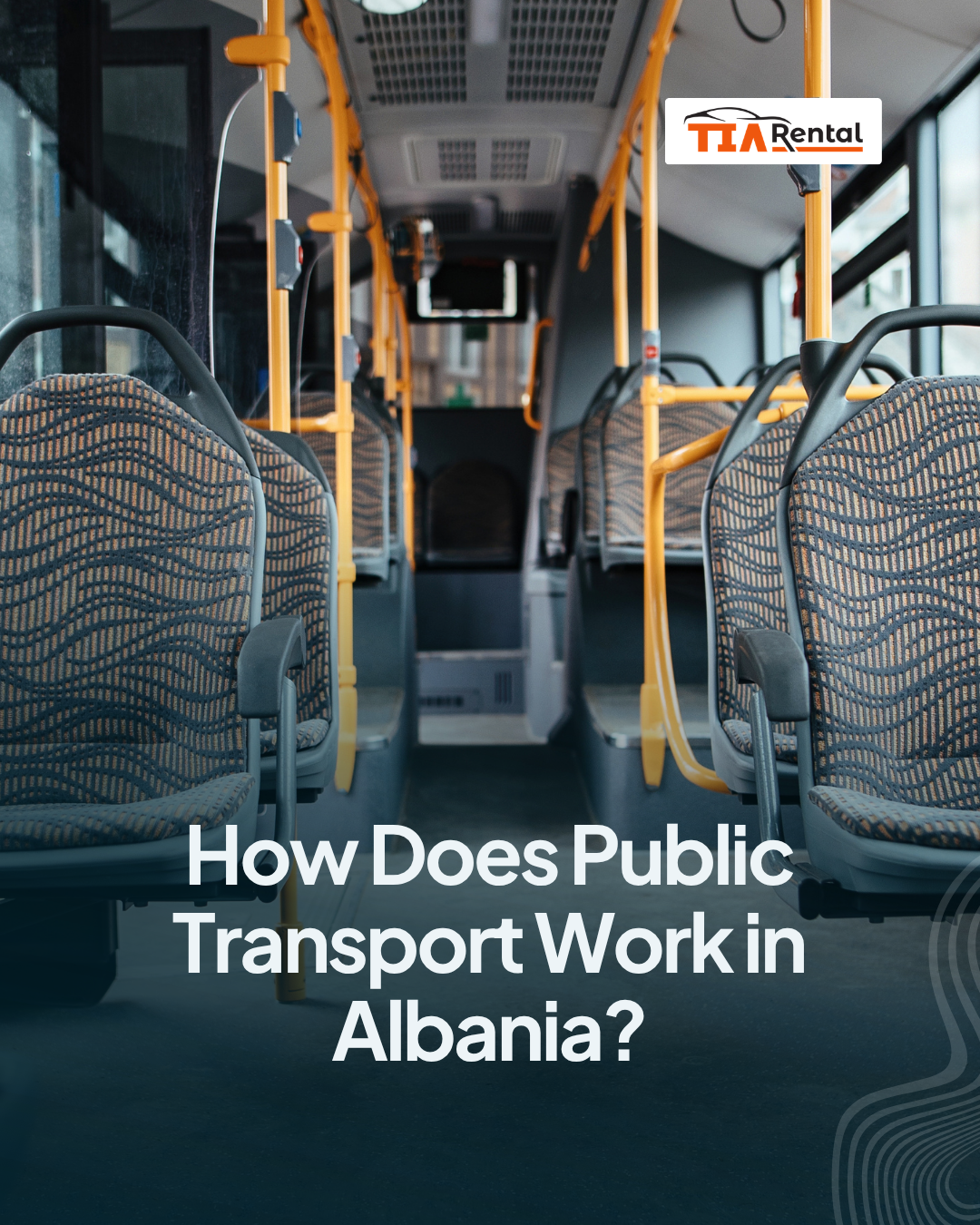
It works, it is cheap, and it runs on local knowledge rather than published schedules. Buses connect every city you would want to visit, a city ticket costs about 40 lek in cash, and nobody will be able to show you a live map of where your bus is right now.
None of that makes it unusable. It just means the planning happens differently here, and it is worth knowing how before you build a two week trip around it.
How do city buses work in Tirana?
You get on, and a conductor comes to you.
Tirana runs around 16 city routes, roughly from early morning until late evening. A single ride costs about 40 lek, paid in cash to the conductor once you are aboard. There is no ticket office to find beforehand and no card to tap.
Two things follow from that. First, carry small notes, because handing over a large one for a 40 lek fare is nobody’s favourite moment. Second, the ticket is for that ride on that line. This is not a city where one pass covers the network.
How do I find the timetable?
Mostly, you ask.
This is the part that surprises people most. Official schedules exist in places, but they are treated as a rough guide rather than a promise. Anita Hendrieka, who has lived in Albania since 2017, compiled her own timetable resource precisely because the official ones could not be relied on, and she is direct about why: buses often leave earlier than posted when the vehicle fills up, or considerably later.
That is the single most useful thing to understand. The bus is not waiting for the clock. It is waiting to be full.
Travel guides written by people who have actually done it say the same thing, that schedules are hard to find online and stops are not always marked on maps. So the real timetable is the driver, the person at the counter, or your guesthouse owner. Ask the night before, and ask again in the morning.
How do I get from one city to another?
You find the right terminal, and the terminal is usually not in the middle of town.
In Tirana, the national bus terminal for both northern and southern routes sits roughly 6 km outside the centre, out towards Kamëz, and you reach it on city bus 5B or a taxi. So a journey to Sarandë begins with a journey to the edge of Tirana, with your luggage, before the actual journey starts.
Every city has its own arrangement, and terminals have been known to move. Check where yours is on the day rather than trusting a blog post, including this one.
How often do the buses actually run?
It depends enormously on the route, and this is where trip planning gets real.
On the busy corridors you barely need a plan. Tirana to Durrës or Tirana to Shkodër tends to run every 15 to 30 minutes through the day.
The long routes are the thin ones. Tirana to Sarandë, the journey most visitors actually want, is served by only about three or four buses a day, typically early morning, around midday, and late afternoon. Miss the afternoon one and you are not going today.
The prices are genuinely good. Rough guide fares from Tirana run to around 4 euro for Shkodra, 5 for Berat, 6 for Vlora and 12 for Sarandë. For a single hop between two cities, that is hard to argue with.
What is it actually like?
Comfortable enough, and more confusing than most people expect.
Travellers who have used the network describe it as one of the more bewildering systems they have met, mainly because the information you would normally rely on is not written down anywhere. The buses themselves are fine for a couple of hours. Nobody comes back complaining about the seats. They come back describing the twenty minutes of uncertainty before boarding.
Cash matters here too. You pay on the bus or at the counter, in lek, and there is no card machine waiting to save you.
So should I rent a car instead?
Depends honestly on the trip you are planning.
Take the bus if you are going from one city to another and staying put, you are travelling light, and your schedule has slack in it. On a Tirana to Shkodër hop it is cheap, frequent and completely sensible.
Rent a car if your trip looks like most Albania trips actually look. That means several stops, luggage, a beach that is twenty minutes past the last bus stop, and the Llogara Pass in the middle of it. The country’s best parts are the ones with no terminal: the coastal road above Dhërmi, the villages behind Berat, a stretch of water you saw from the road and wanted to stop at.
The tiring part of bus travel here is not the ride. It is standing at the edge of a city with bags, not certain when the next departure is, on a day you wanted to spend somewhere beautiful.
Quick answers
How much is a bus ticket in Tirana?
Around 40 lek for a single city ride, paid in cash to the conductor on board.
Can I pay for buses by card in Albania?
No. Bring cash in lek, for both city buses and intercity routes.
Is there an app that shows Albanian buses in real time?
No. There is no live tracking, and schedules are not reliably published online.
How often do buses go from Tirana to Sarandë?
Only about three or four a day, so it needs planning in a way that Tirana to Durrës does not.
Where is the Tirana bus terminal?
The national terminal for northern and southern routes is about 6 km outside the centre near Kamëz, reachable on bus 5B.
Getting the most out of the trip
If your plan is two cities and a slow week, the bus will do the job and save you money.
If your plan is to actually see Albania, the coast road, the mountains, the village someone told you about, then a car turns a logistics problem back into a holiday. That is what we do. We are TIA Rental, we rent cars to travellers across Albania, and you can pay in euro cash or by card when you collect, so you do not need to sort out lek first. Book at tiarent.al.
Before you set off, our guide to driving in Albania, official rules and traffic fines covers the speed limits and the documents you need in the car.