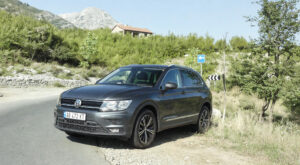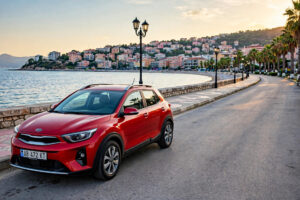
Albania is one of the most interesting countries to drive in Europe. Not the most relaxing, but genuinely one of the best. If you are planning a trip and wondering what driving in Albania is actually like, here is the honest version from a tourist who just completed a two-week road trip across the whole country.
The core thing to understand before anything else: driving in Albania is vibes-based, not rule-based. That does not mean lawless. It means the rules exist and the enforcement exists, but the day-to-day flow of traffic is shaped more by what everyone on the road is doing at any given moment than by painted lines or posted signs. Once you accept that, driving in Albania becomes manageable. Until you do, every kilometre costs you something in stress.
Why Driving in Albania Feels Different
There is a balance to find between knowing the official rules and reading what the people around you are actually doing. Outside a small corridor in central Tirana, the A1 and A2, there are no limited-access roads in the country. Cars enter and exit at any point. Vehicles stop mid-shoulder to load or unload. An invisible centre lane sometimes appears when a driver decides they have waited long enough. You may see livestock on the road. It genuinely resembles rural America from thirty years ago, in the most charming possible way.
You cannot set cruise control and zone out the way you would on an American interstate. Attention has to stay on what is actually happening in front of you. That sounds intense but becomes second nature within a day.
Speed, Pace and What to Expect Day to Day
Coming from western Europe or the USA, the first thing you notice is that everything moves slower. Speed limits are lower because the roads are smaller and there is more going on. In cities, the limit is typically 40 km/h. On highway sections, you are looking at 90 to 110 km/h. The practical experience is usually slower than the posted limit, particularly on mountain roads and through towns where something is always happening at the edge of the road.
The best description for what driving in Albania feels like day to day: a mix of country roads and Mario Kart. You are relaxed but completely present. You are reading the road rather than following GPS blindly. It rewards attentive drivers who are comfortable with the unexpected and do not need everything to follow a script.
Traffic Signals and How Intersections Work in Albania
Outside of Tirana, traffic signals are essentially absent. Intersections are mainly roundabouts, and the larger junctions are managed by traffic police. Officers stand at busy crossings and direct traffic by hand. This is not a backup system for when signals fail, it is how the intersections function.
If you see a large number of police officers on the roads, do not read this as a sign of trouble. They are the traffic system. Police presence at intersections is normal and expected, particularly during busy periods in summer.
Police Stops in Albania: The Honest Version
Traffic stops in Albania are nothing like the USA. There is no adrenaline spike of a police car pulling up behind you with lights flashing. The process is calm and works in pairs: one officer monitors traffic from a distance using radar, and a separate team at the next intersection flags down the relevant vehicle. One officer handles the stopped car; the other continues directing traffic.
During two weeks of driving across Albania, we were stopped once in total. Our travel companion was stopped more often, largely because German temporary plates triggered document requests at nearly every checkpoint. Each stop went the same way: Who are you, what are you doing, have a nice day. Not confrontational, not slow.
One of those stops involved a genuine violation: an illegal overtake on a two-lane road, the kind an Albanian driver might make after sitting in traffic for too long. The officer happened to be stationed right at that spot. He spoke English, issued the fine, payment was made on the spot, and that was the end of it.
Traffic enforcement in Albania is real. Vibes-based does not mean lawless. The enforcement mechanism is police presence rather than cameras and automated systems, which means you handle situations on the road rather than receiving letters in the post six weeks later.
If you get stopped: show your passport, stay calm, and be patient. An international driving permit helps at checkpoints but is not always required. Officers are generally accommodating toward tourists who are clearly finding their way.
Traffic Fines in Albania, How They Work
Fines in Albania are significantly cheaper than equivalent violations in western Europe or the USA. You can pay at any Western Union bill pay station in cash, or at any Posta Albania branch. Paying within a short window after receiving the ticket earns a discount of up to 20 percent.
Do not ignore them. Fines are tracked by plate number and will flag if unpaid. One experience makes this clear: a parking ticket received in Saranda was forgotten. On re-entering Albania from Greece, the border flagged it. A phone call, a payment of roughly 15 euros, and it was sorted, but it caused an unplanned delay at the crossing. Pay the tickets when you get them.
One important rule worth knowing from the outset: Albania’s blood alcohol limit for drivers is 0.01 percent, which is effectively zero. If you plan to drive, do not drink. This is one of the strictest limits in Europe and it is enforced.
Road Conditions: Better Than YouTube Made It Look
If you researched Albania by watching travel videos, you may have come away worried about road quality. The reality is better than that. The main roads across the country are in good condition. Even the two-lane mountain passes are often recently resurfaced with minimal potholes. Albania’s road infrastructure has improved rapidly and is broadly the best in the Balkans.
The comparison becomes immediate when you cross into Montenegro: roads on the Albanian side are generally smoother and better maintained. The RAC’s Albania driving guide notes that infrastructure has improved markedly on major tourist routes, though secondary roads in rural areas still vary.
The one caveat: if your navigation routes you through a specific village and up a secondary road, that road may be in poor condition. But as a general rule, concern about Albanian road conditions is overstated for travellers sticking to the main tourist circuit.
Night driving is worth avoiding on mountain sections. Lighting is sometimes absent, and hazards are harder to read after dark.
Two Routes Worth Knowing
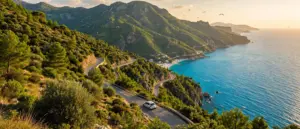
One of the best drives in the country runs along the coast from Saranda to Vlore through Borsh and Himare. It takes longer than the inland option and involves sustained switchbacks that are not for the cautious. If you are not comfortable on a manual gearbox through tight mountain bends, rent an automatic for this stretch, it makes a real practical difference. You also have the choice of going through the new Llogara Tunnel or taking the old mountain road over Llogara Pass. The pass adds time. It earns every minute back in views over the Ionian coast.
The second route worth knowing is Saranda to Tirana via Gjirokastra. Head out of Saranda, through the hills, across the mountains toward Tepelena. The Tepelena area has natural springs and roadside stands selling local honey and olive oil, which is reason enough to slow down. From there drive toward Fier, then choose between routing through Durres or coming into Tirana through Elbasan instead. Elbasan adds 10 to 20 minutes but is a prettier drive and often faster than the Durres approach when there is construction or congestion. For detailed route information across the country, Visit Albania’s official tourism portal covers road access and seasonal conditions for every region.
Parking in Albania: The Part Nobody Warns You About
The hardest part of driving in Albania is not the mountain passes, not the police checkpoints, not the livestock on the road. It is parking. In dense cities like Saranda and Tirana, cars stop wherever they want, not occasionally, but routinely.
In Saranda, which has no traffic signals at all, the entire flow of traffic is managed by horns and the occasional traffic officer. Someone double-parks and blocks a lane. Horns start. Either the driver comes back and moves the car, or a police officer eventually appears to sort it out. The system works more often than it has any right to, but from the outside it looks like chaos.
The most useful thing we learned: drive into the city, park as soon as you find something reasonable, and then walk. Do not try to find street parking close to each specific destination. Look for accommodation that includes private parking or a garage and factor that into the booking. Locals in Saranda told us they barely use their car inside the city at all. They drive it in and out for longer trips and walk everywhere else. That approach is worth adopting from your first day.
Accept that someone will probably give you unsolicited parking instructions in a language you do not understand. Treat it as local helpfulness and do your best.
Which Car to Rent for Driving in Albania
The type of car matters more in Albania than in most countries, and it is worth thinking about this before you book.
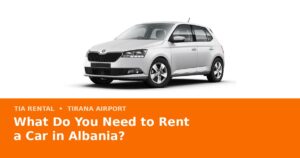
For highway driving between cities, comfort over distance is what counts. For smaller villages and old-town streets, a compact car is far easier to manage in tight spaces. For the coastal switchback road between Saranda and Vlore, an automatic gearbox removes a genuine source of stress through the bends. For northern mountain tracks toward Theth, a 4×4 is the appropriate choice. For most of the standard tourist circuit, a comfortable sedan or compact handles everything without over-spending on capacity you will not use.
The general rule: match the car to the hardest part of your itinerary, not the most comfortable part. Unless your trip specifically includes off-road sections, a smaller car will serve you better in the cities and old towns than a large SUV will.
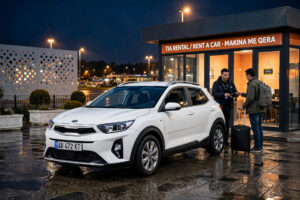
TIA Rental is 100 metres from Tirana Airport arrivals, family-owned and operating since 2010, rated 4.9 across more than 600 reviews. The team can advise on which car suits your specific route before you arrive. There is no deposit and no credit card required.
Frequently Asked Questions About Driving in Albania
Do I need an international driving permit to drive in Albania?
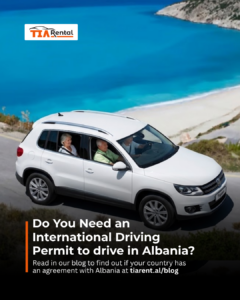
It helps but is not always required. EU licence holders drive without issue. Non-EU drivers from the USA and elsewhere will find that most police interactions go smoothly on a passport and home licence alone, but an international driving permit adds reassurance at checkpoints, particularly for longer trips or if you plan to cross into Montenegro or Kosovo.
How much are traffic fines in Albania?
Significantly less than equivalents in western Europe or the USA. Parking tickets in smaller towns can be around 15 euros. More significant violations are proportionally priced but still modest by western standards. Pay within the discount window to reduce the amount by up to 20 percent. Use Western Union bill pay stations or any Posta Albania branch.
Is it safe to drive in Albania as a tourist?
Yes. Roads are in better condition than most visitors expect. Police interactions are calm and professional. The driving culture is assertive but not aggressive. First-time visitors typically adjust to the rhythm within the first day on the road. Stick to daylight hours on mountain sections and you will find the experience manageable.
What is the hardest thing about driving in Albania?
Parking in dense cities. Not the mountain passes, not the checkpoints, not the livestock. Finding and managing parking in Saranda or central Tirana is where most drivers find genuine difficulty. The practical solution is to park once when you arrive and walk, rather than moving the car between each stop throughout the day.
What is the blood alcohol limit for driving in Albania?
0.01 percent, which is effectively zero. Albania operates one of the strictest blood alcohol limits in Europe. If you plan to drive, do not drink. This is enforced.
Is Albania’s road network better than its neighbours?
Yes, particularly when compared to Montenegro, North Macedonia, and parts of Greece. Main roads on the primary tourist circuit are well-paved and often recently resurfaced. Secondary roads in rural areas vary. Overall, Albania’s infrastructure is among the most improved in the Balkans over the past decade.
Planning to drive in Albania? TIA Rental is 100 metres from Tirana Airport arrivals. Family-owned since 2010, rated 4.9 in 1,300+ reviews on Google. No deposit, no credit card required, unlimited kilometres. Call +355 68 59 08 114 or book at tiarent.al.